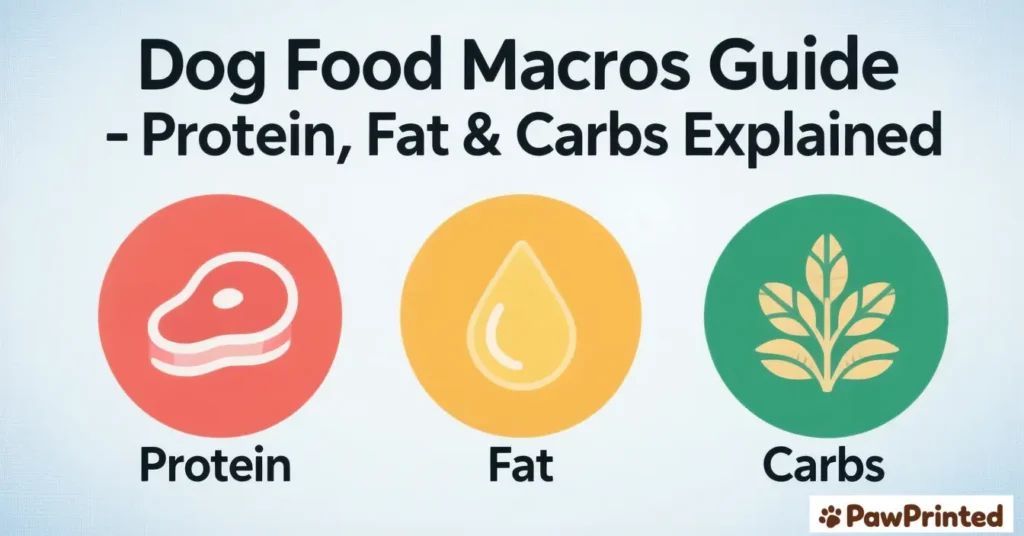
If you have ever stared at a dog food label and thought, “Protein looks high… but is that actually good?” this dog food macros guide is for you. Instead of chasing a “perfect formula”, we are going to make protein, fat, and carbs feel simple enough that you can glance at a label (or your homemade recipe) and know whether it is in the right neighborhood.
Think of macros as the way you decide what goes on your dog’s plate: how much muscle-building protein, how much skin-loving fat, and how many steady-energy carbs. Once you understand those three levers, you can make better choices whether you cook at home, mix homemade with store-bought, or lean on a trusted prepared food.
In this guide, we will walk through what macros are, how much of each most dogs actually need, how to tweak the mix for puppies, seniors, sensitive tummies, and weight loss, and how to spot the early signs that your current balance is off. No calculator obsession, just clear ranges, practical examples, and real-life scenarios you can actually use.
Quick Takeaways For Busy Dog Parents
- Protein does the heavy lifting for muscles, immune health, recovery, and satiety. Most healthy adult dogs do best when protein provides a big chunk of their calories, especially in homemade diets.
- Fat is concentrated energy and carries key fatty acids for skin, coat, and joint comfort. Too little can leave dogs dull and hungry, too much can upset digestion and add weight fast.
- Carbs are not the enemy. The right carbs add fiber, support gut health, and provide steady energy, especially for active or sensitive dogs who do not thrive on all-meat formulas.
- There is no single “perfect ratio”. The sweet spot for macros depends on age, activity, health history, and body condition score. You are aiming for a safe range, not a mathematical trophy.
- Labels and recipes are just a starting point. Your dog’s stool quality, weight trends, coat, energy, and bloodwork are what confirm whether your macro balance is actually working.
What Are Macros In Dog Food, Exactly?
“Macros” is short for macronutrients: protein, fat, and carbohydrates. These are the big building blocks of your dog’s diet, the parts that provide calories and shape how full, energetic, and physically supported your dog feels day to day.
Protein provides amino acids that build and repair tissues, support immune function, and help maintain lean muscle. Fat delivers concentrated energy, essential fatty acids, and carries fat-soluble vitamins. Carbs (including fiber) help with steady energy, gut motility, stool consistency, and can be a gentle way to feed sensitive dogs when chosen well.
Micronutrients like vitamins, minerals, and trace elements still matter a lot, but macros are the “frame” of the diet. If the macro frame is wildly off, even the best supplements cannot fully rescue the recipe. That is why this dog food macros guide focuses on getting the big pieces into a safe, sensible range first.
Why Macros Matter Even More In Homemade Dog Food
With commercial dog food, the macro balance is usually fixed and formulated to meet AAFCO or FEDIAF guidelines. You may love or dislike the ingredient quality, but at least the math has been pre-calculated. Once you move into homemade dog food, you are the one deciding how much meat, fat, and carb goes into every bowl.
That is both the magic and the risk. It is very easy to slide into “all meat, very little fat, almost no carb” or the opposite: “lots of carbs and fat, not enough protein”, especially if you are loosely following a human-style recipe or copying a social media post that was never vetted by a veterinary nutritionist.
For example, a homemade beef and rice bowl can be incredible for a sensitive stomach when the macros are balanced, or very heavy and greasy if the fat is too high. If you notice yourself constantly improvising, it might be worth pairing your kitchen creativity with something like our Portion & Serving Size Guide for Homemade Dog Food or using tools from Best Dog Food Making Tools to keep things more consistent without turning dinner into a math exam.
Safe Macro Ranges For Different Types Of Dogs
There is no single percentage that fits every dog, but most vet-aligned homemade plans for healthy dogs land in a similar neighborhood. Below is a simple way to think about macros by dog type. These are directional ranges, not strict prescriptions, so always adjust based on your vet’s guidance and your dog’s specific health needs.
Puppies & Growing Dogs
General pattern: higher protein, moderate fat, moderate digestible carbs.
Why: growth, brain development, and immune maturation require plenty of high quality protein and fat, backed by appropriate calcium and phosphorus balance.
Where to go deeper: pair this section with Puppy Dog Food Guide before you commit to a purely homemade plan.
Healthy Adult Companion Dogs
General pattern: moderate to high protein, moderate fat, balanced carbs and fiber.
Why: most adult dogs do well when protein remains generous, fat is not excessive, and carbs are chosen for digestibility and gut support.
Helpful support: use our Homemade Dog Food Guide if you are just getting started.
Active, Working, Or Sport Dogs
General pattern: high protein, higher fat, moderate carbs tailored to workload.
Why: intense exercise burns through calories fast. Adequate fat helps support energy, while protein preserves lean muscle.
Next step: see High Energy Dog Food Guide if your dog trains or competes regularly.
Seniors & Lower Activity Dogs
General pattern: moderate protein, slightly lower fat, thoughtful carbs and fiber.
Why: joint comfort, weight control, and organ health matter more than packing in calories.
Deep dive: combine this with Senior Dog Food Guide and Joint Support Dog Food Guide if stiffness is creeping in.
Weight Loss Dogs
General pattern: higher protein, lower to moderate fat, controlled calories, strategic fiber.
Why: protein preserves lean mass while reduced fat and balanced carbs help bring calories down without constant hunger.
Where to start: read Weight Loss Dog Food Guide and, if you prefer commercial options, Best Dog Food for Weight Loss Guide.
Sensitive Stomach & Digestive Issues
General pattern: moderate protein from gentle sources, moderate fat, easily digestible carbs, adequate fiber.
Why: extremes in either direction (too rich or too low fat) can trigger flare-ups. The goal is a calm, predictable macro mix.
Helpful reading: Sensitive Stomach Dog Food Guide and Dog Food for Diarrhea Guide walk through the details.
Protein: The Main Character In Your Dog’s Bowl
If macros were a movie, protein would get top billing. It is responsible for building and repairing muscles, supporting immune cells, forming hormones and enzymes, and helping your dog feel satisfied after a meal. In homemade diets especially, protein quality and quantity are central to whether the recipe feels “complete enough” in real life.
For most healthy adult dogs on a homemade plan, you want protein to take up a generous share of the calories, sourced from a mix of animal proteins and, where appropriate, carefully chosen plant proteins. Too little, and you may see muscle loss, low energy, and poor coat quality. Too much stacked on top of high fat can overwhelm some dogs, especially those with liver or kidney concerns.
Each protein brings a slightly different amino acid and fat profile. Lamb, beef, and pork often feel richer, while turkey, chicken, and many fish-based options can be leaner or more omega-focused. If you are building recipes around one primary protein at a time, it is worth exploring ingredient-focused pieces like Lamb Dog Food Guide, Beef Dog Food Guide, Chicken Dog Food Guide, and Salmon Dog Food Guide to understand what each adds to the macro picture.
Fat: Energy, Coat Glow, And Joint Comfort
Fat is the macro people either fear or secretly love. It carries more than double the calories of protein or carbs per gram, so it is powerful. It also delivers essential fatty acids that keep skin supple, coats shiny, and joints more comfortable, especially when omega 3 and omega 6 are in a healthy balance.
A common homemade pattern is accidentally sliding into very high fat because fatty cuts of meat, chicken skin, and cooking oils add up fast. Some dogs handle that richness well, but others end up with soft stools, weight gain, or even pancreatitis if there is a history of digestive sensitivity. On the other side, obsessively trimming every bit of fat can leave active dogs looking more tired and “flat”.
If your dog has joint or skin issues, dialing in fat quality matters just as much as quantity. You may find it helpful to cross-check this section with Omega Rich Dog Food Guide, Skin Support Dog Food Guide, or Coat Health Dog Food Guide so you are not relying on guesswork when you adjust oils and fatty ingredients.
Carbs: Gentle Energy And Gut Support, Not The Villain
Carbs in dog food get blamed for a lot of problems, but the real story is more nuanced. In the right form and amount, carbohydrates provide steady energy, help shape healthy stools, and feed beneficial gut bacteria. In homemade recipes, they are often the key to making meals feel satisfying without pushing fat into uncomfortable territory.
The trick is choosing carb sources that match your dog’s digestion. Dogs who struggle with wheat or corn might do much better with rice, oats, quinoa, or root vegetables like sweet potatoes. Higher fiber choices can be especially helpful for dogs with anal gland issues or mild constipation, while some sensitive dogs need a more limited, simple carb lineup.
If you are experimenting with grain free or limited ingredient approaches, it is worth reading High Fiber Dog Food Guide, Limited Ingredient Dog Food Guide, and Anti-Inflammatory Diet for Dogs Guide so that carb decisions support digestion instead of accidentally making it harder.
How To Adjust Macros Based On Your Dog’s Real Life
Once you understand the basic roles of protein, fat, and carbs, the next step is learning how to make small, safe adjustments based on what you are seeing at home. You do not need macro tracking apps or spreadsheets. You just need clear signals and gentle course corrections.
- If your dog is always hungry but not underweight: increasing protein slightly or improving protein quality can help, as can adding low calorie fiber. Check in with our Low Calorie Dog Food Guide if you are trying to avoid weight gain.
- If stools are soft or greasy: your fat level may be too high, or the combination of fat and carb is too rich. Gradually shift toward leaner cuts, reduce added oils, and simplify carb choices.
- If coat looks dull or skin is flaky: do not just blame protein. Look at fatty acid balance and consider omega support, ideally aligned with guidance in Omega Rich Dog Food Guide.
- If weight is creeping up: gently lower fat and overall calories, keep protein solid, and use carbs and fiber strategically as you would in a Weight Loss Dog Food Guide style plan.
- If energy feels flat: confirm you are not underfeeding total calories. Then look at whether you have gone too low on fat for an active dog, or whether carb choices are too heavy and sleepy-making.
Whenever you change macros, make those shifts slowly. Combine what you see at home with regular vet checkups and, where needed, bloodwork so you can catch early hints that something is off long before it becomes a real health problem.
Signs Your Macro Balance Is Working (And When It Is Not)
Instead of obsessing over exact percentages, pay attention to how your dog’s body is responding. The checklist below is often more useful than any macro calculator.
When Macros Are In A Good Range
- Weight is stable around an ideal body condition score, not creeping up or down.
- Stools are mostly well formed, easy to pick up, without chronic diarrhea or constipation.
- Coat feels soft and has a natural shine, with minimal dandruff or itchiness.
- Energy feels appropriate for your dog’s age and breed, not wired or sluggish all the time.
- Bloodwork and vet exams come back within normal ranges for key organ markers.
When Macros May Be Off Balance
- Frequent soft stools, greasy residue, or alternating diarrhea and constipation.
- Weight gain despite normal portions, or unexplained weight loss without a plan.
- Coat losing shine, more shedding than usual, or new itchy patches with no clear allergy trigger.
- Dog seems constantly hungry, raids the trash, or begs more than usual after meals.
- Vet flags early changes in kidney, liver, or lipid values that might be tied to diet.
If you are seeing more “off balance” signs than “good range” signs, it might be time to zoom out and evaluate whether your current recipe or brand choice matches your dog’s life stage and health profile. Sometimes the fix is as small as trimming extra fat and adding a more digestible carb. Other times, it makes sense to step back to a well-formulated base, like a vet-aligned commercial option from Best Fresh Delivery Dog Food while you recalibrate.
How All Of This Looks In A Real Kitchen
Picture a pretty typical story: you start cooking for your dog because of allergies, a sensitive stomach, or just wanting cleaner ingredients. At first, you throw together chicken, rice, and some veggies. Your dog is thrilled. Stools look better. You feel proud. Then a few months in, weight is creeping up, your vet mentions slightly elevated lipids, and you realize you have been a bit heavy handed with the oil and skin-on cuts.
Instead of giving up on homemade dog food, you step back and reframe the bowl using this dog food macros guide. You keep protein high enough to support lean muscle, trim the fat down slightly, choose carbs that your dog digests well, and tighten up portions using the Portion & Serving Size Guide for Homemade Dog Food. To keep things realistic on busy weeks, you also pick a “safety net” option from Best Backup Food for Homemade Diets so you are not forced into random takeout for your dog when life gets messy.
Over time, that mix of macro awareness, portion control, and a few smart product choices from hubs like Find the Right Dog Food for Your Life – A Real-World Selection Hub usually works better than any promise of a perfect percentage. The goal is not a spreadsheet. The goal is a dog who looks and feels obviously well.
Author note from Emma, Founder at PawPrinted: “When I first started cooking for Ethan, I was obsessed with copying every macro I saw in online recipes. It finally clicked when our vet said, ‘Let us use labs, weight, and how he looks to judge the recipe, not just the numbers.’ This guide is meant to give you structure, but your real feedback is always the dog in front of you.”
Ready To Put Macros Into Action?
If you are excited to tweak your dog’s protein, fat, and carb balance but do not want to figure it all out from scratch, these next reads and tools can make the process feel much lighter and more practical.
Dog Food Macros Guide: Frequently Asked Questions
1. Is there a single best macro ratio for all dogs?
No, there is not one universal macro ratio that fits every dog. Different ages, activity levels, and health conditions all change how much protein, fat, and carbs a dog can comfortably handle. A young active dog may thrive on a higher fat and protein mix, while a senior with joint issues and slower metabolism may need moderated fat and a tighter handle on calories overall. Instead of chasing a perfect percentage, it is more useful to work within safe ranges and pay attention to real life markers like weight stability, stool quality, coat condition, and energy. If those look good and your vet is happy with labs and body condition, your current macro balance is probably doing its job, even if it does not match a formula you saw online.
2. How do I know if my homemade diet is too high in fat?
Common signs that a homemade diet is too rich in fat include frequent soft stools, greasy or shiny stool surfaces, unexplained weight gain, or a dog that seems a bit sluggish after meals. In dogs who are already prone to pancreatitis or digestive flare-ups, a very high fat intake can trigger vomiting, abdominal discomfort, or more serious episodes that need urgent veterinary care. If you are frequently using skin-on meats, cooking oils, fatty cuts, or rich add-ins like cheese, it is worth stepping back and gently trimming fat down while keeping protein steady. A good next move is to choose leaner cuts, reduce added oil, and keep a consistent recipe for a few weeks so you and your vet can evaluate whether things are improving.
3. Do dogs actually need carbohydrates if I am feeding enough meat?
Dogs can survive on very low carbohydrate diets, but that does not mean every dog will thrive on them. Well chosen carbohydrates can provide steady energy, support gut motility, and add fiber that helps with stool quality and anal gland health. For many real world dogs, especially those with sensitive stomachs, joint issues, or weight concerns, a moderate amount of digestible carbs and fiber makes meals more filling and easier on the digestive system than an all meat plan. The key is to pick carb sources that your dog handles well, such as rice, oats, quinoa, or root vegetables, and to avoid simply loading up on cheap fillers. If you are curious about grain free or limited ingredient approaches, review your dog’s response with your vet instead of assuming lower carbs are automatically better.
4. How often should I review my dog’s macros with a vet?
A good rule of thumb is to check in with your vet about your dog’s diet and macro balance at least once a year, and more often if you are actively making changes or if your dog has a medical condition. Puppies, seniors, and dogs with kidney, liver, or digestive issues may need more frequent monitoring and bloodwork to make sure the current recipe supports organ health over time. Any time you change the primary protein, fat level, or overall calorie density of your homemade plan, it is worth looping your vet in so they can help you watch for early signs that something needs adjusting. Treat these reviews as gentle tune ups, not grades, and bring photos, notes on stool, weight trends, and a typical recipe to make the conversation more concrete.
5. What if I like homemade food but cannot manage perfect macro tracking?
You absolutely do not need perfect macro tracking to feed your dog well. For most families, the best approach is a hybrid: pick one or two trusted base recipes that were designed with veterinary input, keep those fairly consistent, and then make small, thoughtful tweaks over time instead of reinventing the bowl every week. On extra busy days, having a backup plan like a high quality commercial option that fits your dog’s macro needs can remove a lot of pressure and guilt. If keeping everything homemade feels overwhelming, you can also use a mixed strategy: part homemade, part well chosen prepared food from a resource like a fresh delivery brand or a guide that helps you evaluate ingredient lists with more confidence. The goal is sustainable care, not perfection.